

Journaling Four Ways
Getting our thoughts, ideas and feelings down can free us up

Each morning after pouring the coffee and petting the cat, I open my notebook and start writing my morning pages. This is a freewrite. Stream of consciousness. No rules other than to scribble across the page.
I’ve been doing it for 2,051 days now, with an occasional break or two. I know because I write the number on the top of each page, next to the date. The count has moved through dozens of notebooks, multiple inks, and fountain pens, too.
Sometimes I rant or stumble into new ideas or questions while I’m writing. Sometimes my scrawl is about pens and inks, weather, and football games. Though the topics are rarely weighty, the practice is. It grounds me. It’s meditative. It helps me to understand myself and the world.
Most of us move through the day without noticing. My Morning Pages routine requires my physical presence and mental attention. In return, I feel more engaged during the day.
No matter what forms it takes, journaling provides an opportunity to reflect, notice, think, feel. It can help us to see ourselves in a new way and dive deep into our emotions.
And the page can also give us a little distance from our thoughts and the space to consider and process them.
How it Helps
Writing slows things down so you can see your thoughts and feelings. Over time, you start to notice patterns in your thinking, your triggers, and your reactions. Once you see those patterns, you can question them. Is this true? Is it helpful?
Journaling is also linked to creativity, improved mood, lower distress, and even physical benefits like better immune function and faster healing, according to research.
Keep it Simple
You don’t need a complex system to keep a journal. Some loose guidelines can help you be consistent.
The real power of journaling for me has been the repeated practice of sitting down, taking stock, and putting thoughts on the page. Don’t judge what you write. Don’t get caught up in any rules. Allow yourself to relax into the page and explore whatever comes to mind. Keep it consistent and manageable. A short, regular practice matters more than length.
You need only a few minutes and something to write in and with. I’m a big advocate of writing longhand. It slows us down, helps us focus, and minimizes distractions. I also like the visceral feel of my hand on the paper.
Journaling Four Ways
Julia Cameron’s Morning Pages approach consists of writing three pages, whatever comes to mind, each morning before doing anything else.
Perhaps, you would rather journal at the end of the day with a diary approach. Record what you did, but go deeper and reflect on what some of those moments meant to you, share your frustrations and successes. To boost optimism, end your entry by commenting on something you are looking forward to in the day ahead.
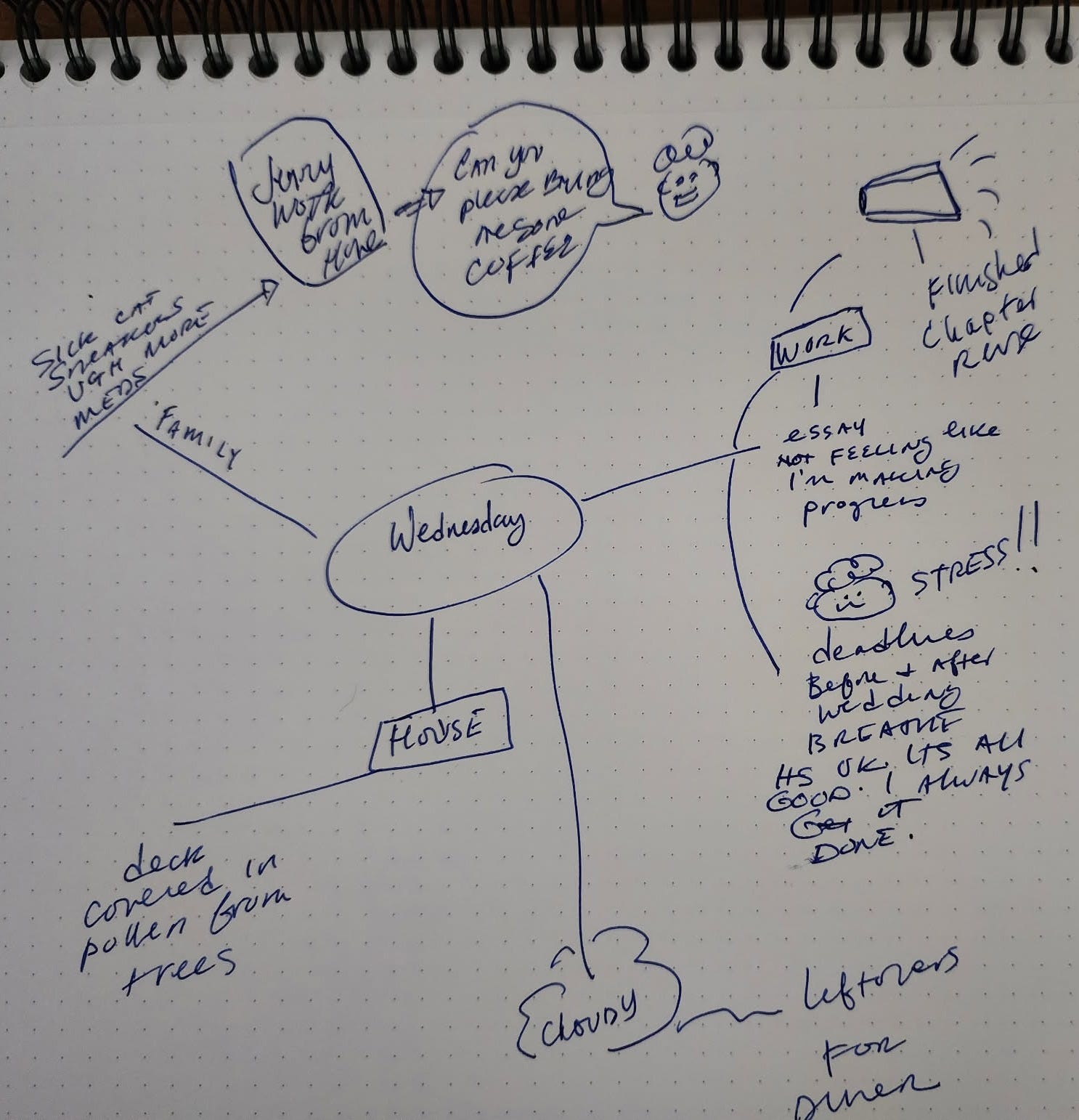
When I feel like I can’t write another word, I’ll do a mind map (see the photo above for an example of one of mine) or visual notes. I’ll drop a feeling, moment, or even the day of the week in the middle of the page, just a single word, and connect other related ideas with lines and shapes and arrows to it, so I get a visual of my day and ease the clutter in my mind.
Some days it feels like we have accomplished nothing. This is when a mind map can be clarifying by providing a physical representation of the different “boxes” we checked off and all that we managed. I’m intentional about including at least one thing on my mind map that feels like a success. And I celebrate that by writing it in.
Or try a logline journal. I’ve used this specific approach when developing a book idea, and I want to get a handle on what it’s about. Scriptwriters often use this to shape or even pitch their movies, but it’s a fun approach to journaling too.
A logline entry in your journal is a one or two-sentence entry that includes who, an event or action, an obstacle/challenge, and an ultimate goal or resolution. Don’t worry too much about form or the rules here; we aren’t going for art. We are just documenting our lives.
A few days ago, I wrote this logline journal entry: Took Sneakers to the vet, and she bit me when I pulled her out of the carrier. She got a blood test to check her kidney function. I got a tetanus shot and a doctor’s appointment to check for infection.
We are both OK. And, I did make a note of that in my gratitude journal.
-p

I love the mind map journaling idea—definitely going to try that one!
I journal long hand at the end of each day. My only rule is that it has to make sense.